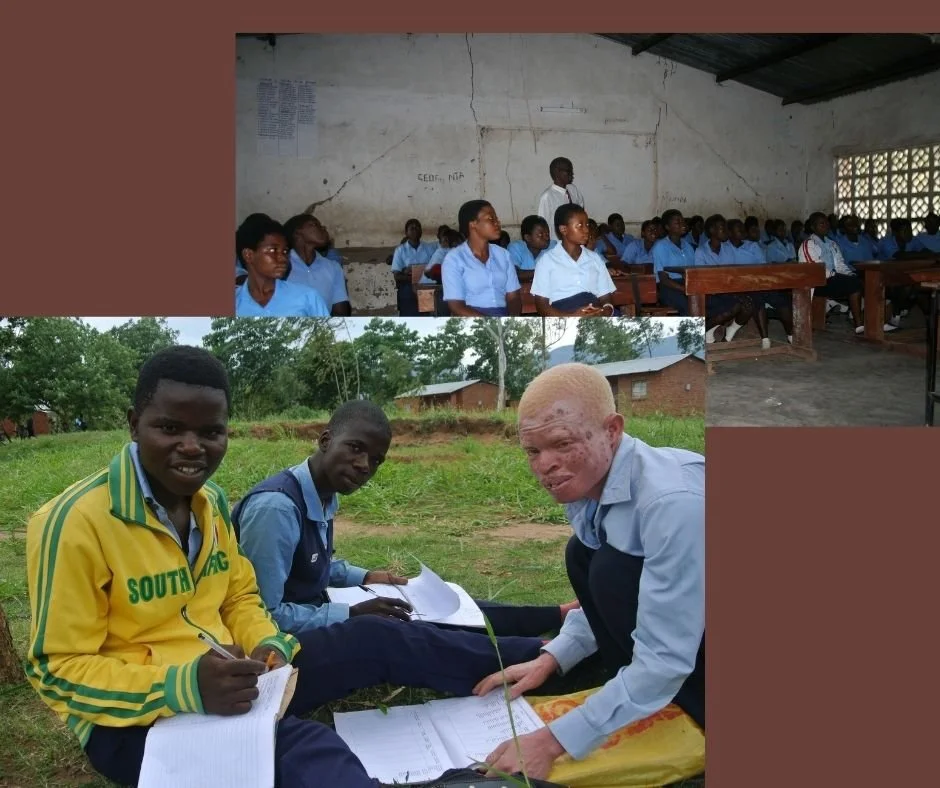
HIGH SCHOOLS IN MALAWI
Malawi's secondary schools run a bit differently to the U.S. system.
From how schools are built, to how schools receive resources and staff, to how grades progress. Before students can attend any secondary school, they must pass the primary school exam (PSLCE).
Community Day Secondary Schools (CDSS), like our partner school, Nsondole CDSS, are sponsored by their community, quite literally.
CDSS school buildings are literally built by the community, from forming and drying bricks to furnishing with doors, windows, and chalkboards. Once the CDSS is established, the government provides teachers and limited resources. Historically, student tuition fees provided the rest of the school's budget.
CDSSs can become Community Hubs
The Mother's Group is an example group at our partner school of how a CDSS can become a community hub. The Mother's Group has continued to stay engaged in our Women's Empowerment Program. They are a group of women from the area that help educate the female students on menstrual hygiene.
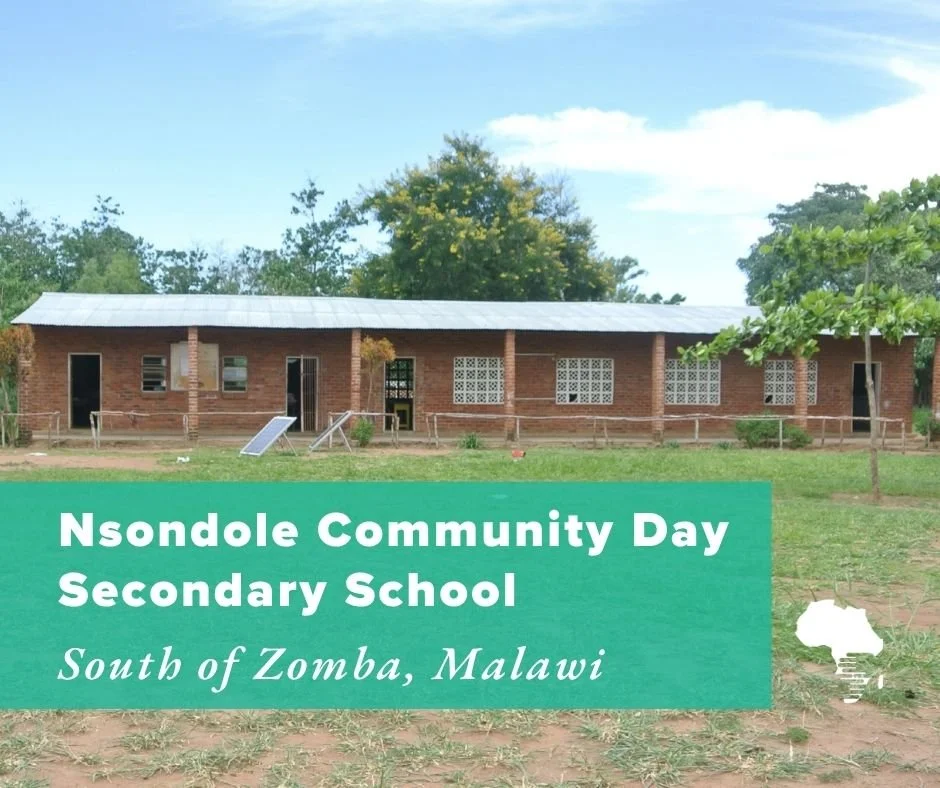
Nsondole CDSS school building, South of Zomba, Malawi
Open Secondary Schools (OSS) also provides education in rural areas
however classes occur outside of school hours at existing school buildings, and the ages of grade cohorts are less restricted.
OSS's offer secondary education to learners who pass the PSLCE but are not selected into secondary schools due to limited space. OSS cohorts of students are more fluid and open.
OSSs offer access to education for interrupted learners, adult learners, and more.
Many students in the community around Nsondole CDSS finish a grade, and then do not have an opportunity to continue consecutively because they need to help out at home. While this is not an ideal situation, it does give a student the opportunity to graduate with the equivalent of a high school diploma in a 'non-traditional' way.
RECENT CHANGES IN CDSS SCHOOLS
An Update to School Fees
Starting in January of 2026, the government of Malawi started paying for CDSS school tuition, as part of the Malawi 2063 Agenda. The agenda puts emphasis on educating the youth for the betterment and future of Malawi. Their goal is to make it achievable for every student to obtain a high school diploma, and in turn, the students will use that education and skill and put it back into the Malawian economy.
With students’ tuition being paid for, what does this mean for Story Time’s Student Sponsorship Program?
While the students of Nsondole CDSS’s tuition is being paid for, the other pressures which affect them are not changing. Students who are identified as being the most in-danger of dropping out still have financial, social, and familial pressures–from taking care of aging guardians and younger siblings, to helping with harvest, to being too injured to walk to school.
Students still need desks, notebooks, uniforms, mathematical and scientific instruments to obtain a well rounded education. Story Time can also shift our focus onto infrastructure projects; Community leaders (Mother’s Group, PTA, guardians) continue to recommend a proper functioning library as well as more bathrooms.
We continue to ask for your generous donations, become co-authors of Story Time, and sponsor the students by giving them a chance to make a difference in this world through their education.
With as little as $10 a month, you can make a notable difference in a student’s education. Or support our work by sharing the story on social media, subscribing to emails, or signing up to volunteer. Become a co-author today!